When students get back their test paper, there are usually two main groups.
The first group ignores the outcome, be it good or bad, and just "moves on". The second group looks at the mistakes and "aiya, sh*t, careless", and that's about it.
Whichever group you are in, I feel that it's not right. There is a third group, very small group. This group of students look at their mistakes thoroughly, learn from them and try to recall why they made the mistake in the first place. Then they vow not to make the same mistake again.
Tests and exams are not the end, they are just mile markers on a much longer journey. I wrote about this in my earlier post: Failure Is The Mother Of Success. Failure is not only forgivable, it is necessary. The point is not to punish yourself, not to forget the pain, but to learn and grow from it.
The point is this: a test that you ignore is just a test. A test that you analyse properly becomes a stepping stone. Failure is only useful if you extract the lesson from it.
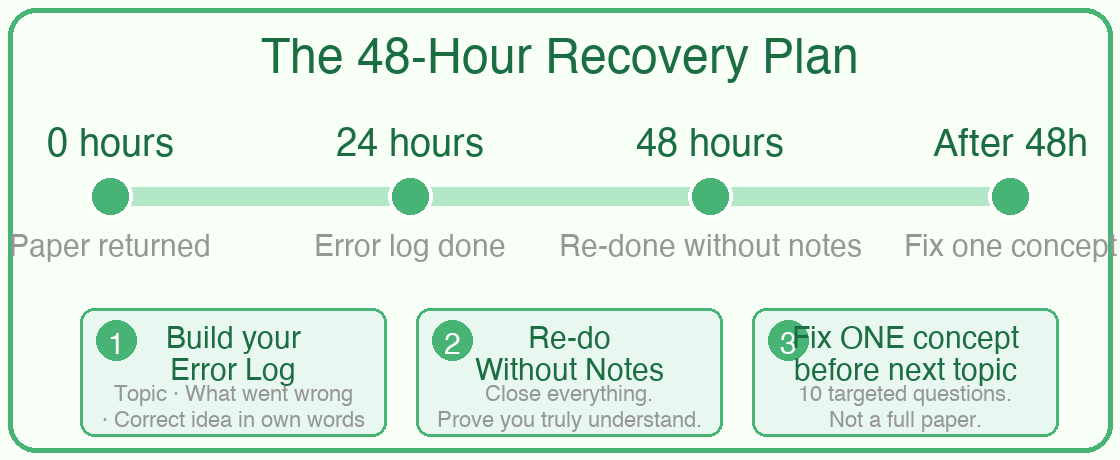
So here is what I recommend: a 48-hour recovery plan. Three steps. Simple but effective.
The first group ignores the outcome, be it good or bad, and just "moves on". The second group looks at the mistakes and "aiya, sh*t, careless", and that's about it.
Whichever group you are in, I feel that it's not right. There is a third group, very small group. This group of students look at their mistakes thoroughly, learn from them and try to recall why they made the mistake in the first place. Then they vow not to make the same mistake again.
Tests and exams are not the end, they are just mile markers on a much longer journey. I wrote about this in my earlier post: Failure Is The Mother Of Success. Failure is not only forgivable, it is necessary. The point is not to punish yourself, not to forget the pain, but to learn and grow from it.
The point is this: a test that you ignore is just a test. A test that you analyse properly becomes a stepping stone. Failure is only useful if you extract the lesson from it.
So here is what I recommend: a 48-hour recovery plan. Three steps. Simple but effective.
Why 48 hours specifically?
I don't expect students to be free everyday. At the same time, if this drags for too long, students will lose interest and will definitely forget about the paper.
48 hours just feels manageable to me. When a student tells me "I will review properly during the June holidays", I know from experience that most of the time, it simply does not happen. He/she would have either moved on or would be busy doing other things, whether preparing for the next paper or enjoying.
Do it within 48 hours. Here is how.
Step 1 (Hours 0–24): Build your error log
Take the paper out. Yes, I know. That is the hard part. But do it.
Go through each question you got wrong. For every mistake, write one line in your notebook with exactly three things:
1. Which topic(s) is the question from?
2. What went wrong. Do not just write "careless". If it's careless, you can try writing "I didn't see the mass of the box in line 2."
3. The correct idea in your own words.
For example:
Differentiation | Forgot chain rule when function is inside function | Always check first: is there a composite function? If yes, apply chain rule.
Probability | Used P(A∪B) = P(A) + P(B) on non-mutually exclusive events | Check whether events are mutually exclusive first. If not, must subtract P(A∩B).
This is your error log. It is not a punishment. It is a map of exactly where the gaps are.
When I was a student, I failed common test after common test in certain subjects. Looking back, the reason I eventually improved was not because I worked harder in general — it was because I became very specific about which exact step I was getting wrong. Vague effort gives vague results. Specific effort gives specific improvement.
One important note: the error log must be specific. "Careless" is not a category. If you write "careless" next to a question, you have not done this step properly. Dig deeper — was it a transfer error? A wrong formula applied? A condition you did not check? (See my post on the careless mistake myth for the five real causes.)
Step 2 (Hours 24–48): Redo the paper without your notes
After building the error log, close your notes and your textbook.
Now redo every question you got wrong. Do it under exam conditions. No referring to notes.
This step matters because it separates understanding from familiarity. Many students read the model answer, think "oh, so simple lah!", and move on. But when they face the same question type in the next paper, they don't know how to start. Why? Because reading someone else's solution and being able to produce it yourself are two very different things.
The only way to prove to yourself that you truly understand is to test yourself without any support. If you can redo the question correctly, the concept has landed. If you cannot, that is actually great news, because now you know exactly what to fix, which brings us to step 3.
I have used this method myself many times. In secondary school, after a poor Additional Mathematics test, I would redo every wrong question the following evening without referring to anything. It was painful at first. But the questions that I could not redo told me where I needed to spend my next hour of study. That one hour was always far more productive than three hours of general revision. There were times where I redo the whole paper, including those that I got correct for, just to make sure that it was not just luck that I got them correct.
Step 3: Fix one concept before moving to the next topic
Look at your error log. One pattern will almost always emerge. Several mistakes will trace back to the same root concept. Maybe it is partial fractions. Maybe it is the modulus function. Maybe it is probability addition rules.
Pick the single most important one.
Then drill that concept, maybe 10 questions on that topic, before you move on to the next chapter. Not a full paper. Not random practice. Targeted repetition on the exact thing that failed.
The problem with "just do more practice papers" is that if you have a gap in concept X, doing 50 questions that all test concepts X, Y and Z together will leave you confused about where the real gap is. Drill concept X in isolation first. Plug the hole before you keep building on top of it.
This is exactly why I spend so much time on fundamentals during my lessons. If the root concept is shaky, every topic built on top of it will collapse sooner or later — and you will be wondering why you "still cannot do it" even after so many practices.
What about the emotional part?
I am not going to pretend a bad test does not sting. It does. I have been there many times.
When I was in Secondary 2, I scored so badly and genuinely considered leaving school. When I could not complete my C programming exams in NUS, I questioned whether I belonged there at all. These were real feelings, and they were not fun.
But I learned one thing over the years: the feeling and the action are two separate things.
You are allowed to feel bad. You do not have to feel positive. You do not have to tell yourself "it's okay, I will do better next time!" immediately. Give yourself a few hours to breathe.
But then, tonight or tomorrow morning, open the paper. Write the error log. The action does not require you to feel motivated. It just requires you to start.
The students who improve fastest are not the ones who never feel discouraged. They are the ones who do the work even when they feel discouraged.
A note for parents
If your child comes home after a bad test, the most unhelpful question is "why so careless?" and the most helpful question is "which part did not go well, and what can we do about it?"
Give them a few hours to breathe. Then sit with them for 20 minutes and go through the paper together. You do not need to know the subject. Just ask: which questions got full marks? Which ones were wrong? For the wrong ones, do you know how to do already?
To my students
If you just had a bad test and you are reading this, good. The fact that you are reading means you have not given up.
Follow the plan. Build the error log tonight. Redo without notes tomorrow. Fix one concept before the next chapter begins.
The next test is coming. The question is not whether you will face it again, it is whether you show up better prepared than you were this time.
If you want help going through the errors and identifying which concept to drill, that is exactly what I do in 1-to-1 tuition. Feel free to contact me — online or in Yishun. We can turn this paper into a proper stepping stone.
All the best. :)