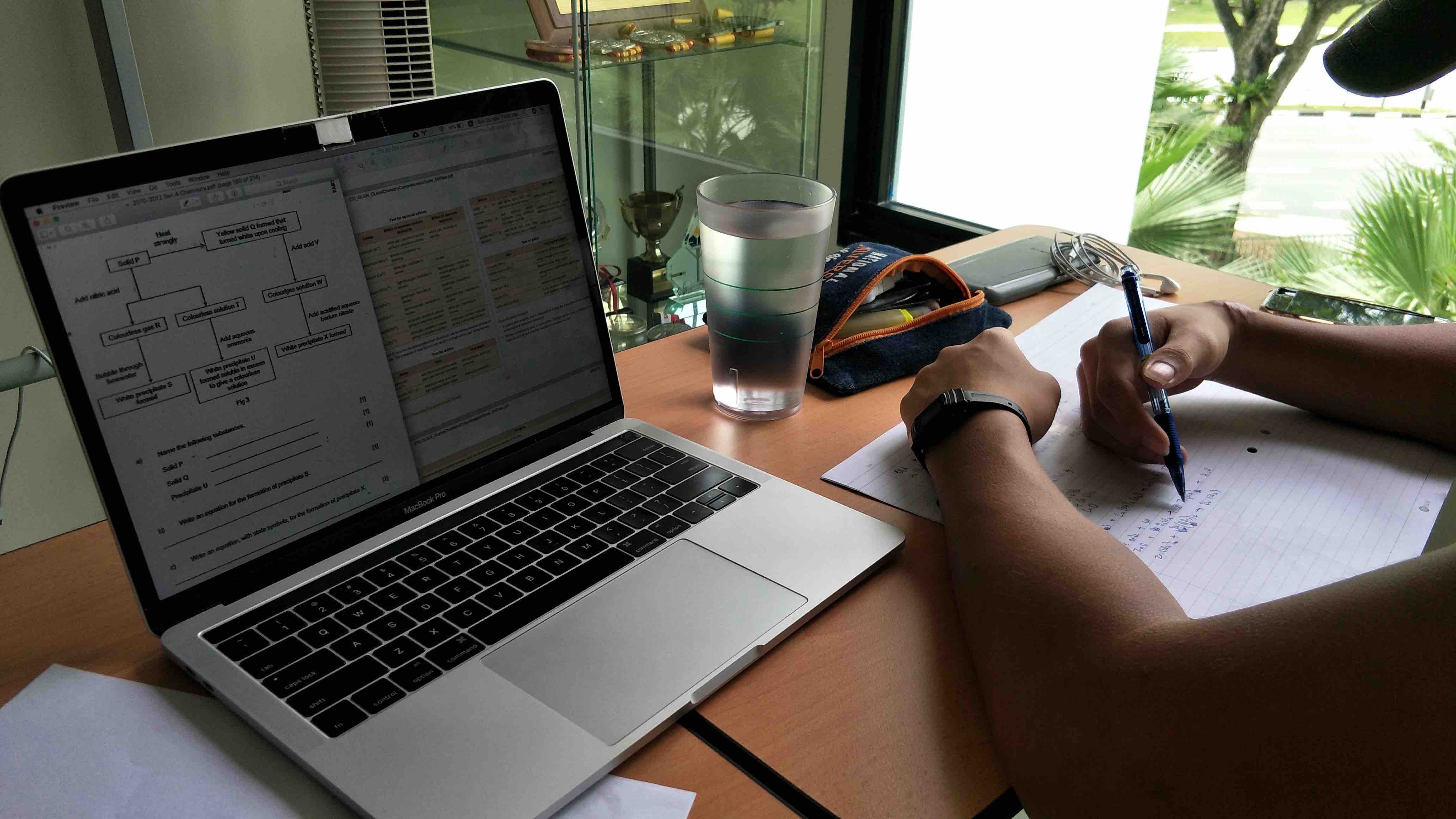
After every test, I hear the same line from students (and parents): "Aiya, wasted, got one careless." Students always lose marks on a question they "already knew how to do". Then they would say they will be more careful next time.
I am not saying carelessness does not exist. But in all my years of teaching Math and Science (from O Level to H2, to even Poly and University), I find that most "careless" errors fall into a few patterns.
In this post, I will share five causes and practical fixes. This is related to what I always tell students: build strong fundamentals first (see my post on understanding and mastering the basics).
I am not saying carelessness does not exist. But in all my years of teaching Math and Science (from O Level to H2, to even Poly and University), I find that most "careless" errors fall into a few patterns.
In this post, I will share five causes and practical fixes. This is related to what I always tell students: build strong fundamentals first (see my post on understanding and mastering the basics).
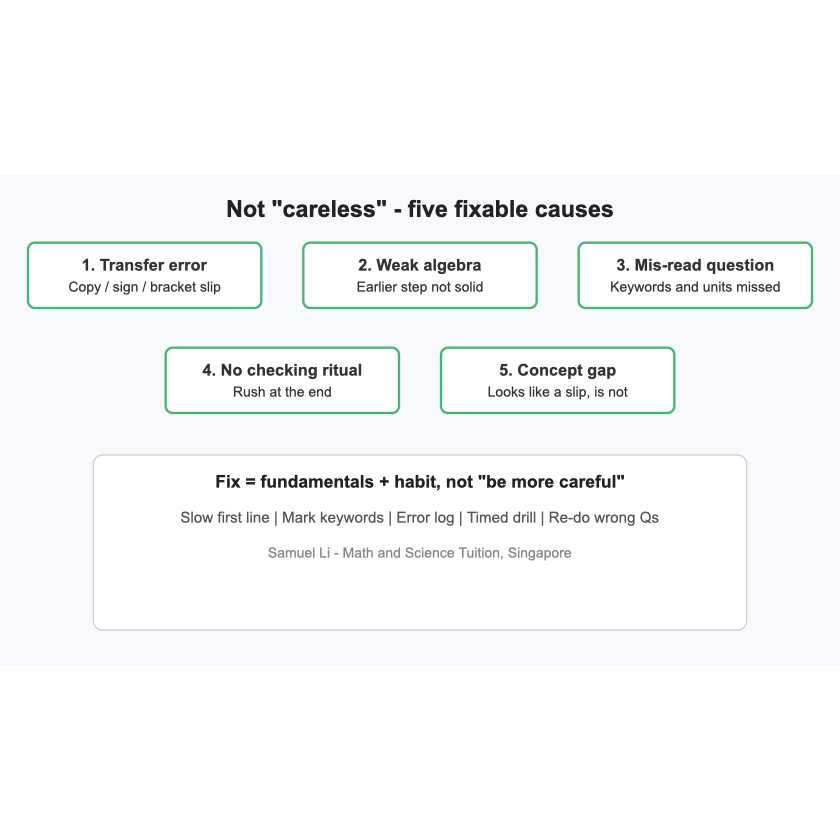
The "careless mistake" myth
"Careless" sounds like bad luck — one wrong digit, one misread line, gone. That label feels comforting because it does not ask us to change how we study. But exams are not testing luck. They test whether you can execute a method correctly under time pressure.
If the same type of error happens again and again, it is not careless. It is a habit — or a gap — waiting to be fixed.
Cause 1: Transfer error (copying, signs, brackets)
You solved the question correctly in your head or on rough paper, but the final line on the answer script is wrong. Classic examples: copying -3 as 3, dropping a square, losing a bracket when expanding (a+b)².
Fix: Write the first line slowly. After every 2–3 lines, glance back at the previous line only — not the whole page. For sign-heavy topics (integration, vectors), box the final sign before you move on. In tuition I make students say the sign out loud once; it sounds silly but it works.
Cause 2: Weak algebra (the mistake started earlier)
Many "careless" calculus or trigonometry errors are really algebra errors from Sec 3 or Sec 4. If you are shaky on fractions, indices, or factorising, the later step will collapse — and you will blame the last line.
Fix: When marking your paper, trace backwards from the wrong answer. Ask: which step first went off track? Drill that skill in isolation (10 questions on that sub-skill only), not another full paper. This is exactly why I focus on fundamentals in lessons — so H2 Math does not become "fancy algebra with extra steps".
Cause 3: Mis-read the question (keywords and units)
Students answer a different question from the one asked: "exact value" vs decimal, "hence" vs fresh start, "show that" vs solve, cm vs m, inclusive vs exclusive. Under time pressure the brain fills in what it expects to see.
Fix: Before calculating, underline three things: what is given, what is required, and any conditions (domain, range, units). Spend 20 seconds — it saves 5 minutes of wrong working. I also recommend staying calm to analyse the situation; panic makes mis-reading worse.
Cause 4: No checking ritual (only rushing at the end)
"Be careful" usually means "check everything at the end when I have 3 minutes left". By then you are tired and you skim. Real checking is built into the attempt, not bolted on at the end.
Fix: Use a short ritual every question: (1) estimate or bound the answer if possible, (2) substitute back for equations when quick, (3) sanity-check units and magnitude. For MCQ, try one other method if time allows. Timed practice helps — see exam preparation: time factor — so the ritual becomes automatic, not panicked.
Cause 5: Concept gap disguised as a slip
Sometimes the working looks fine until one step that is actually wrong in principle — e.g. adding probabilities that are not mutually exclusive, wrong choice of identity in trig, integration without checking domain. The student labels it "stupid mistake" and moves on. Next paper, same step fails again.
Fix: Keep an error log in a notebook (I wrote about this in Keep A Notebook). One line per mistake: topic, what went wrong, correct idea in your own words. Review the log weekly. If the same concept appears three times, it is not careless — schedule a proper revision block or ask your teacher/tutor.
What to do after a bad paper
Do not only re-mark and sigh. Sort errors into the five buckets above. Fix bucket 2 and 5 with concept work; fix 1, 3, and 4 with habits and timed drills. Parents: asking "why so careless?" rarely helps. Asking "which step went wrong?" does.
If you want help sorting patterns and building a personal checklist, feel free to contact me for 1-to-1 Math tuition (online or in Yishun). We can turn "careless" into a list of fixable actions — and that is when marks really move.
All the best for your next paper. :)